Recently, I wrote about the work of our Green Innovation Lab and the three areas we are trying to bring together into one system: energy, environmental and food security.
Water and the World: The Security Challenge We Barely Notice

5 min read
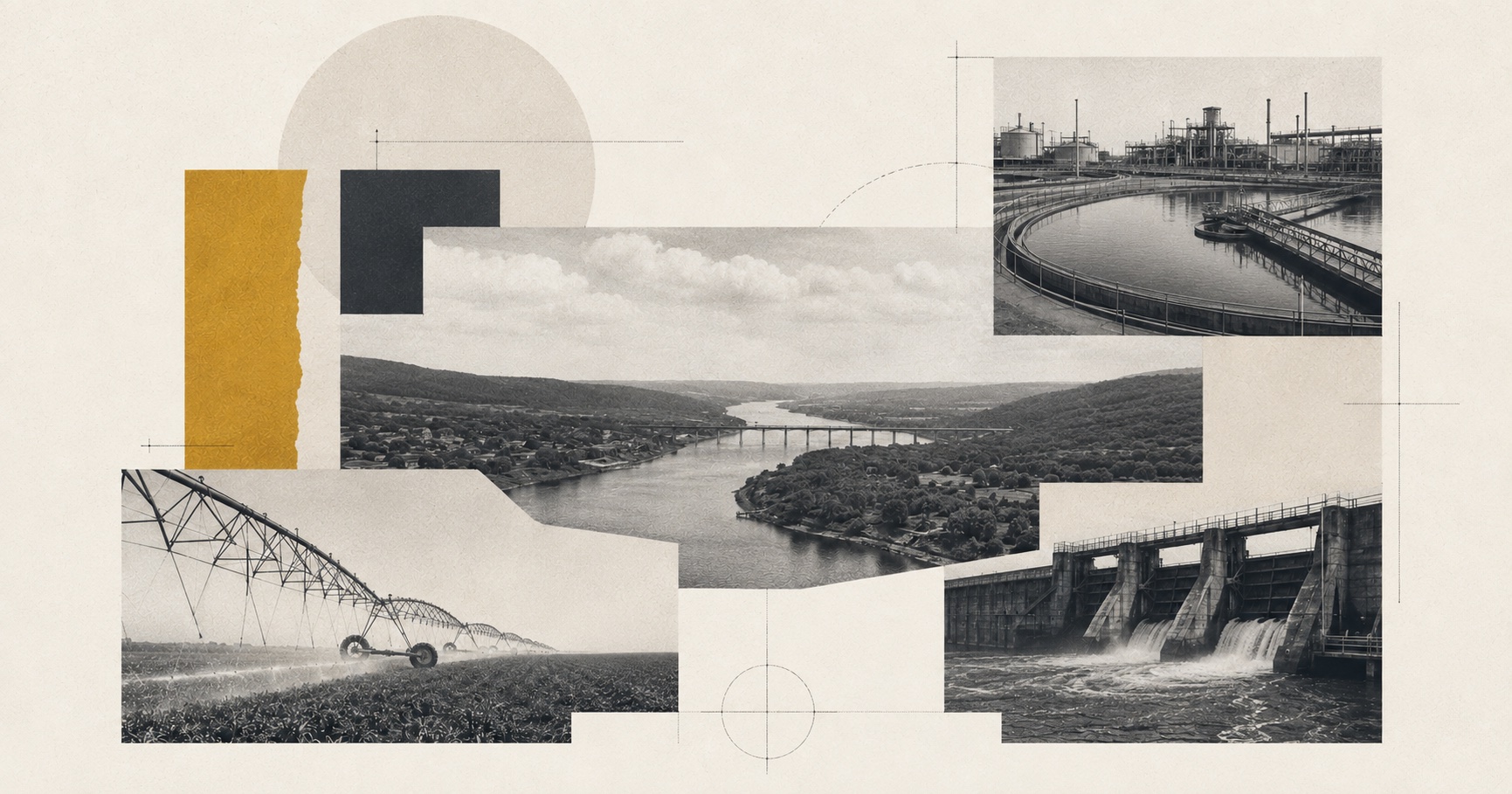
One of our research areas is water. We are working on methods for treating industrial and agricultural wastewater within a circular-economy model. The idea is not simply to treat water before discharge. Treated water should be returned to the consumption cycle, while organic components can become a resource, including for the production of organic fertilisers and the restoration of Ukraine’s soil fertility.
The deeper we work on this subject, the clearer it becomes to me that water is about far more than environmental policy or municipal infrastructure.
A resource that appears limitless
In a country at war, we talk a great deal about energy security. About food security. About critical infrastructure and the resources on which national resilience depends. And rightly so. But without water, neither the energy system, agriculture, industry nor our cities can function.
Water is needed to grow food, generate electricity, cool energy and industrial equipment, operate businesses and hospitals, and sustain cities and entire ecosystems. Yet the resource we tend to take for granted is remarkably limited.
Only about 2.5% of the water on Earth is freshwater. Usable and available freshwater accounts for only around 0.5% of the planet’s total water resources. Today, 2.1 billion people still lack access to safely managed drinking water. Some 3.6 billion face inadequate access to water for at least one month each year.
This is no longer only a humanitarian challenge.
Water is an economic issue
Agriculture accounts for 72% of global freshwater withdrawals. Industry takes another 16%, while municipal use accounts for 12%. Those three figures explain why water scarcity very quickly ceases to be an exclusively environmental problem. Less available water means greater risks for agriculture and food security. For industry. For energy. For cities and communities.
At the same time, demand for water is growing alongside technological development. Water is essential for many industrial processes, semiconductor manufacturing, power generation and emerging technologies. In many cases, what is required is not simply water, but water of very high purity.
For business, therefore, the question is no longer only where water will come from. Increasingly, it is about how efficiently it is used, treated and returned to the production cycle.
Add climate change. And geopolitics
Climate change manifests itself to a large extent through water: droughts, extreme rainfall, changing river flows and glacier loss. At the same time, groundwater aquifers are being depleted, rivers polluted and freshwater ecosystems degraded.
Then there is geopolitics. These days, it is difficult to avoid. Some 153 countries share transboundary water resources. Rivers do not recognise national borders. What one country builds, pollutes or withdraws upstream can directly affect economies, ecosystems and people’s lives downstream.
Managing shared rivers and aquifers is therefore no longer simply an environmental matter. It is an issue of international co-operation, economic interests and security. As water scarcity increases, this dimension will only become more important.
Technology already provides part of the answer
The good news is that many of the solutions we need are already known. Modern water treatment and reuse. Efficient irrigation. Groundwater protection. Rainwater storage. Closed-loop industrial water systems. Restoration of wetlands. Better river-basin management.
In regions facing acute water scarcity, desalination is playing an increasingly important role. Elsewhere, treated wastewater is being returned to agricultural, industrial or municipal use. This is also the logic behind our work at the Green Innovation Lab.
For me, the circular economy is not a fashionable term or an attractive diagram for a presentation. Its meaning is very practical: what is considered waste or wastewater today should become a resource tomorrow.
Treat the water – return it to use. Recover organic components – turn them into fertilisers. Return nutrients to the soil – reduce the need for new resources. That is how we begin to close the loops.
Four separate policies are no longer enough
This is why I am convinced that we cannot manage energy, water, land and food as four separate worlds. They are one interconnected system.
Energy needs water. Water infrastructure needs energy. Agriculture needs water, land and energy. The condition of our soils affects how water is retained and used. And food security depends on the performance of this entire system. Water security, therefore, should not be an appendix to environmental policy. It should become part of national strategic planning, alongside energy and food security.
For Ukraine, this conversation has particular importance. The full-scale war has shown us the true cost of vulnerable critical infrastructure. It has also reminded us, in the harshest possible way, that water can be either a source of resilience or a source of vulnerability for a country.
Do we fully understand this yet? I do not think so. That is why my next article will move from the global picture to Ukraine: what is happening to our water resources, which risks the war has created or intensified, and what a modern architecture of water security should look like.
This issue will not wait for better times.
Read Also
Water and Ukraine. An Old System for a New Reality
In my previous piece I wrote about water as one ...
Read moreBSF Bioeconomy: We Are Creating the Future of Bioeconomy Today
The world has entered a new era, where waste becomes ...
Read moreOur Green Innovation Lab Is Not Just About R&D and Technology. It’s a Search for Solutions and a Response to Global Challenges
Today, science cannot exist in isolation. In our innovation lab, ...
Read more